
The Classroom Context Gap: Shifting AI From Teacher Productivity to Student Thinking
A look at how the UK and Washington State AI guidelines help provide a missing instructional layer in today's practical AI commentary.

Much of the AI-in-education conversation still happens at 30,000 feet.
We hear that AI will transform learning, disrupt assessment, personalize instruction, restructure teacher workloads, threaten academic integrity, prepare students for the future, or change the role of the teacher.
All of that may be true. But too often, the conversation never lands in a classroom: What exactly did the teacher ask students to do? At which point did AI enter (and exit) the task? What did students have to think through? What did the teacher evaluate? What evidence of learning became visible?
This is a glaring classroom-context gap in much of today’s AI-in-education commentary. The discussions here on Subtack, on LinkedIn, and on other platforms are often thoughtful, eloquent, and well-intentioned. But many feel strangely detached from the actual instructional situations teachers face daily. (Even my posts at times, I must admit.)
“Practical AI” often feels disembodied. It appears as a set of prompts or a list of tools, but not as a classroom scenario. It can be bereft of a student task, a teacher decision, and evidence of what students understood.
To be clear, I don’t mean to trivialize these uses. Teachers are overextended. If AI can help a teacher adapt a reading passage, create practice questions, translate key vocabulary, or scaffold a student who is stuck, I am all for it.
But let’s be clear about what kind of AI use this is.
It’s teacher-facing. It’s about AI-supported teaching.
That’s not the same as AI-supported learning.
Sure, students may benefit when a teacher can use AI to create a lesson plan, simplify a text, generate a revision podcast, build a quiz, or draft a slide deck. They may receive clearer materials, more accessible texts, faster feedback, or better scaffolds.
But students are not the ones using AI to test an idea, compare explanations, evaluate feedback, revise their thinking, or explain their reasoning.
A Step Toward Concrete Classroom Guidance
A step towards practical, concrete guidance is the UK Department for Education’s recently updated AI support materials.
Unlike much AI commentary, the UK’s Module 4 on generative AI use cases actually lands in teachers' daily classrooms. It is a national, official, public resource designed to help schools and colleges use AI safely and effectively, and it includes slides, videos, transcripts, summaries, activities, and templates. The collection was updated only a week ago, and Module 4 focuses specifically on use cases of generative AI in education.
There is no obvious U.S. equivalent. Since President Trump gutted the Department of Education, American educators have no national, government-backed, classroom-facing professional learning package that offers practical AI use cases for schools and colleges.
So the UK materials are worth examining, not because I think American teachers should adopt them wholesale, but because they show what practical government guidance can look like.
The UK Module 4 Workbook Gets Concrete
Module 4 is of special interest. It is organized around four broad areas: teaching and learning, inclusion and accessibility, administrative tasks, and business and operations. It offers use cases for teachers, support staff, leaders, and operations professionals, rather than limiting AI to a single classroom tool or a narrow productivity frame.
The teaching and learning examples include lesson content and structure, long-term planning, formative assessment, quiz generation, error feedback, adapting text for style or reading age, generating images, creating exam-style questions, producing visual resources, and creating audio resources such as podcasts or verbal explanations.
This is the kind of guidance many teachers are asking for. Not vague statements about AI disrupting teaching, but rather something closer to: Here is how AI might help you prepare tomorrow’s lesson, adapt this text, support this learner, generate practice questions, or make a resource more accessible.
Inclusion and Accessibility is the strongest section. The workbook lists AI uses such as breaking down tasks, summarizing, explaining concepts further, creating exemplars, building writing frames and sentence starters, translating content, differentiating by reading age, using visual and audio materials for dual coding, converting audio to text, and creating audio descriptions of images.
In all, it’s grounded in the real work of helping students access material.
The UK guidance also repeatedly asks educators to consider pedagogical need, contextualize the example for their setting, align use with teaching and learning policy, protect student data, check outputs for accuracy and bias, and adapt AI-generated materials before using them with students.
That combination — concrete examples plus professional judgment — is exactly what many schools need.
But these same examples also reveal an important limitation.
Practical Usually Means Teacher-Centric
Most of the UK guide’s practical examples follow a familiar pattern:
The teacher prompts AI.
AI creates or adapts something.
The teacher checks the output.
Students use the resulting material.
As I’ve said, the result is often valuable. A simplified text can help a student participate. A translated vocabulary sheet can support access. A scaffolded essay plan can reduce cognitive overload. And a visual description can open up material that might otherwise be inaccessible.
But students are typically the recipients of AI-supported materials rather than active participants in AI-supported learning.
Practical usually means: How can AI help teachers do their work?
This starting point is completely understandable. Teachers are focused on planning, instruction, differentiation, feedback, communication, and the many small decisions that keeps their classrooms going. If AI is going to enter schools responsibly, teachers need low-risk ways to understand what these systems can and cannot do. Teacher-facing use also builds familiarity. It helps educators experience the strengths, quirks, errors, and limitations of AI before asking students to use it.
But if practical AI stops there, AI mostly remains in the preparation layer.
It helps teachers prepare materials, adapt resources, and manage workload. It may improve access. It may make some instruction more responsive. But it does not necessarily change what students do as learners.
Washington Adds the Student-Use Layer
Washington State’s Human-Centered AI Guidance for K–12 Public Schools helps articulate what the UK guide does not fully develop.
Washington’s guidance is not as rich as the UK materials in classroom-ready examples. A teacher looking for dozens of immediate use cases will find the UK Module 4 more useful.
But Washington asks a different question:
How should schools structure AI use so students remain active, ethical, reflective learners?
Its central frame is “Human Inquiry → AI → Human Empowerment.” AI use should begin with human inquiry and end with human reflection, human edits, human understanding, and human empowerment. The guide explicitly warns against letting AI become the final thought, product, or paper.
That’s an excellent instructional frame. As a result:
The question goes beyond simply whether students used AI for learning. The question is what role AI played in the student’s thinking.
Of special note is the section titled “Implementing AI: A Practical Guide for the Classroom.” Washington’s five-step AI scaffolding scale helps teachers move beyond the weak binary of “AI allowed” or “AI banned.” The scale runs from no AI assistance to AI-assisted brainstorming, AI-supported drafting, AI-collaborative creation, and AI as co-creator. At each level, the guidance emphasizes student contribution, revision, transparency, citation, critical evaluation, rationale, and academic integrity.
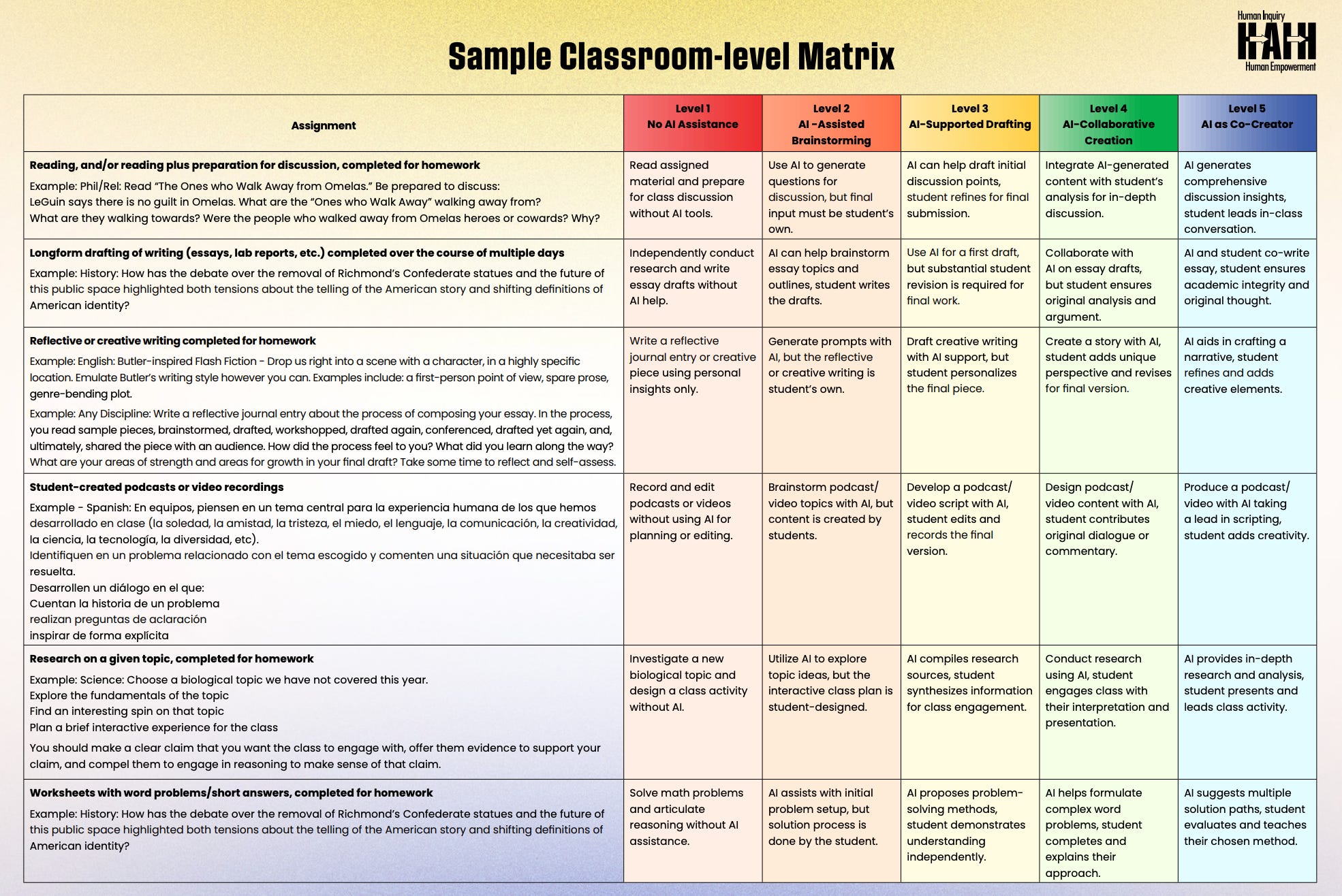
This is a point where many schools are struggling. AI might be appropriate for brainstorming but not drafting. It might be useful for feedback, but not drafting. It might generate counterarguments, but the student still has to evaluate which ones are weak, relevant, or worth addressing. It might suggest multiple solution paths, but the student still has to explain which path makes sense and why.
While I would suggest a slow buildup to Level 4 or 5, Washington’s assignment scaffolding matrix extends this idea across reading and discussion preparation, long-form writing, creative writing, podcasts and videos, research, and problem solving.
That shifts AI guidance from policy into assignment design.
A school policy can say, “Students must cite AI.” A teacher still has to decide what AI use means in a history essay, a biology research project, a Spanish dialogue, a math problem set, or a student-produced podcast.
What kind of AI help is appropriate? What kind would undermine the learning? What process evidence should students produce? How will the teacher know what the student understands?
These are the practical questions schools cannot avoid.
From Detection to Visible Process
If the final product is the only evidence of learning, AI will always create uncertainty. If the process is visible, AI becomes easier to discuss, evaluate, and teach with.
Visible process might include prompts, drafts, annotations, revision notes, reflections, oral explanations, teacher conferences, version history, or disclosure statements. Students might be asked to explain which AI suggestions they accepted, which they rejected, and how their own thinking changed.
In all, this is a step towards better learning design:
A history assignment in which students use AI to generate three possible interpretations of a primary source, then identify omissions, unsupported claims, and missing context before writing their own interpretation.
Or an English assignment in which students use AI to generate counterarguments to a thesis statement, then annotate which counterarguments are valid, weak, or irrelevant before revising their essay.
Or a math task in which students ask AI for two different solution paths to the same challenging problem, then compare the methods, explain which one is more efficient or easier to understand, and then solve a similar problem without AI support.
Or a science investigation in which students ask AI to critique an experimental design, then revise their method and explain which suggestions they accepted or rejected.
Or a world language role-play in which students use AI voice practice, save corrections, re-record, and reflect on grammar and pronunciation. (Something which I do as a language learner.)
These are the kinds of classroom cases we need more often.
A student who can prompt AI but cannot critique AI is not AI literate. Practical guidance should help students check accuracy, identify bias, notice missing perspectives, recognize hallucinations, question overconfident claims, and decide when AI output is not good enough.
Cuban’s Warning Still Looms Large
More than a year ago, I wrote about Larry Cuban’s warning that AI might simply be adapted to the existing contours of schooling — used at the margins rather than forcing educators to rethink how students learn. That warning still applies. If practical AI guidance is limited to teacher productivity — lesson plans, quizzes, emails, summaries, slide decks — then AI may become common in schools while remaining peripheral to learning.
Combined, the UK DfE materials and Washington State guidance suggest a better path. One brings AI down into the daily work of schools. The other helps schools structure student AI use so that thinking, judgment, and academic integrity remain visible.
Practical AI guidance should include both.
It should show what teachers can do with AI: plan, scaffold, adapt, translate, give feedback, communicate, and improve access. But it should also show what students do with AI: question, critique, revise, disclose, explain, and take responsibility for their work.
A practical AI guide should not stop at “Here is what the teacher can generate.” It should show what students do, what AI does, what the teacher sees, and where the learning happens.
The most practical AI guidance will help teachers decide not only what AI can produce, but what students must still think through, struggle with, explain, revise, and own.
Find AI-in-education tools, news, how-tos, consults, and more at tomdaccord.com